

In this post, I provide an overview of the historic development and significance of Glebe Cottage. I was instructed to deliver built heritage advice and prepare a detailed heritage statement for proposed internal works to this important listed building. Listed Building Consent was granted for the internal alterations, which included the blocking of an existing opening on the ground floor, the installation of a new wall and a new opening in a wall on the first floor, and the installation of a French drain.
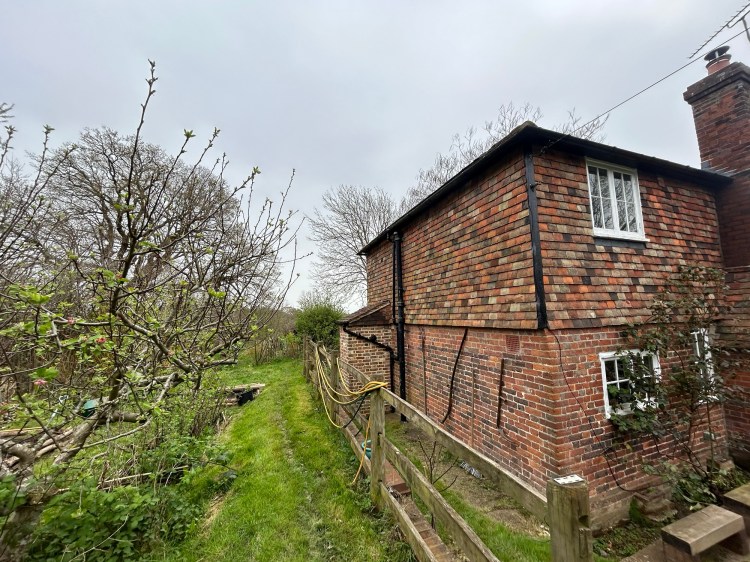
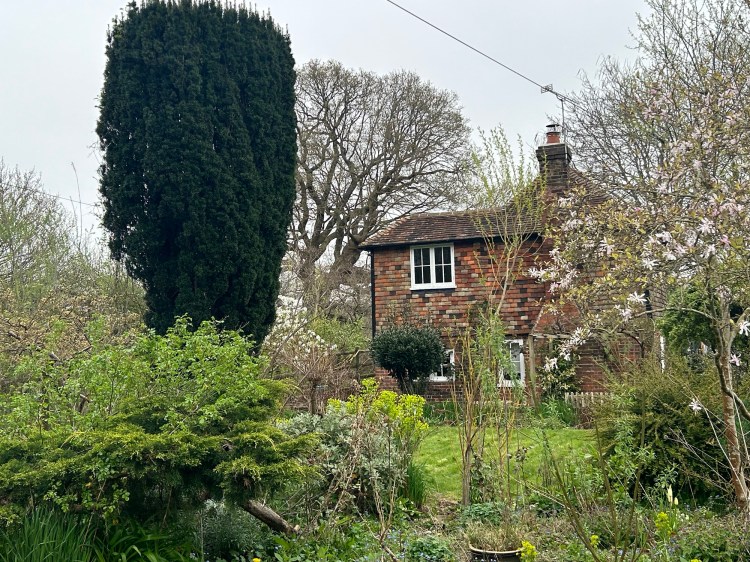
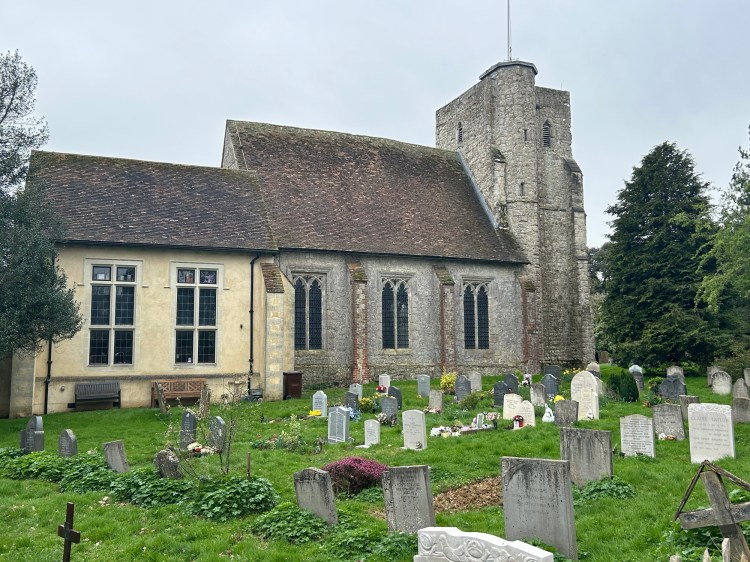
Glebe Cottage is a Grade II listed property situated in the village of Kingsnorth, near Ashford. Dating from the early 19th century, the cottage holds considerable historic and architectural interest. It contributes positively to the character of the Kingsnorth Conservation Area and maintains an important historical association with the Church of St Michael and All Angels, within whose setting it is located.
Development History
The Domesday Book of 1086 references a settlement in Kingsnorth under the jurisdiction of the Manor of Wye. The origin of the name “Kingsnorth” has several interpretations. One theory suggests it comes from the Old English “cyninges snad,” meaning detached land associated with a royal estate. Another that the name stems from the Jutish people known as ‘Kyn‘, meaning kinfolk, who settled on a wooded hill or ‘snode‘. Early variations of the name include Kyngsnode, Kynsnoth, Kyngesnothe, and Kingessnode. Adjacent to the church, there once stood a moated medieval manor house. While the original house site is now occupied by modern structures, the moat still remains. The Victoria County History provides an overview of the area which is worth repeating in full here:
THIS PARISH is so obscurely situated as to be but little known, the soil in it is throughout a deep miry clay; it is much interspersed with woodlands, especially in the south-east part of it, the whole face of the country here is unpleasant and dreary, the hedge rows wide, with spreading oaks among them; and the roads, which are very broad, with a wide space of green swerd on each side, execrably bad; insomuch, that they are dangerous to pass except in the driest time of summer; the whole of it is much the same as the parishes adjoining to it in the Weald, of which the church, which stands on the hill nearly in the middle of the parish, is the northern boundary, consequently all that part of it southward is within that district. There is no village, the houses standing single, and interspersed throughout it At no great distance eastward from the church is the manor house of Kingsnoth, still called the Park-house, the antient mansion, which stood upon a rise, at some distance from the present house, seems from the scite of it, which is moated round, to have been large, remains of Mosaic pavement, and large quantities of stone have been at times dug up from it.
South-eastward from the church is Mumfords, which seems formerly to have been very large, but the greatest part of it has been pulled down and the present small farm-house built out of it; westward from the church stands the court- lodge, now so called, of East Kingsnoth manor, it is moated round, and seems likewise to have been much larger than it is at present, and close to the western boundary of the parish is the manor-house of West Halks, which has been a large antient building, most probably of some consequence in former times, as there appears to have been a causeway once from it, wide enough for a carriage, which led through the courtlodge farm towards Shadoxhurst, Woodchurch, and son on to Halden, remains of which are often turned up in ploughing the grounds. In the low grounds, near the meadows, is the scite of the
manor of Moorhouse, moated round. The above mansions seem to have been moated round not only for defence, but to drain off the water from the miry soil on which they were built, which was no doubt the principal reason why so many of the antient ones, in this and the like situations were likewise moated round. There is a streamlet, which rises in the woods near Bromley green, and slows along the eastern par to this parish northward, and joining the Postling branch of the Stour near Sevington, runs with it by Hockwood barn and under Alsop green, towards Ashford. Leland in his Itinerary says, vol. vii. p. 145, “The river of Cantorbury now cawled Sture springeth at Kinges Snode the which standeth sowthe and a lytle by west fro Cantorbury and ys distant of Cant. a xiiii or xv myles.”
Historic Map Regression
A historic map regression has been conducted to understand the development of the site. The Historic Environment Record, Historic England Archive, and various online resources have been consulted in preparation for the assessment.
Nineteenth Century
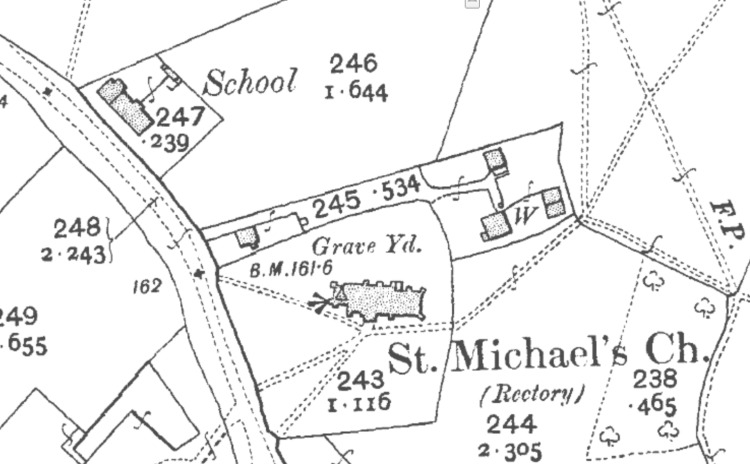
The oldest map from 1843-1893 depicts Kingsnorth village as a compact group of structures situated at the peak of Church Hill. This cluster includes the church and the rectory, now called Mulberry House (previously Whitegates), the cottages near the church known as Glebe and Piran (currently Candlemass) Cottages, Mouse Hall, Mumford Cottage, and the village school. Predominantly dating back to the 18th Century, these buildings showcase the traditional Kentish architectural style, featuring red brick construction, tile-hung or white-painted weatherboarding on the first floor, and hipped tiled roofs. Historically, the site has always been associated with the church, both due to its proximity and use. Historic maps from the 19th century show the wider area, with fields to the northeast and northwest.
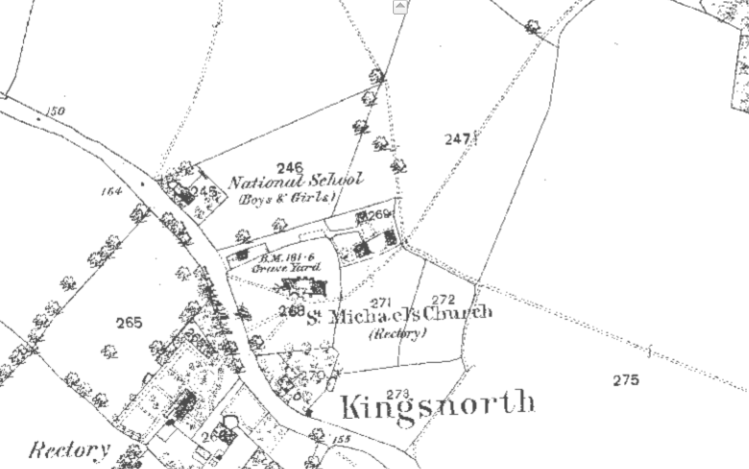
The addition of Mumford House on the west side of Church Hill south of Mulberry House, in the mid-19th Century (see map below), is the sole addition to the village. Despite modern advancements in transport, the village retained its historic layout with little to no development. The site itself saw no extensions or additions during this period.
Twentieth Century
Before the post-1920 infill development, the village saw minimal expansion along the road to the northwest of the church, marked by the construction of the present-day village hall. This growth eventually led to the integration of the adjacent hamlet to the west of Kingsnorth, known as Kingsnorth Pound, into the village. Historical maps from the early to mid-20th century indicate no alterations to the site during this period. While the 1946 aerial photograph is lacking in detail, the 1990 aerial view offers a more comprehensive perspective of the site and its surrounding landscape.
Summary
Historical map analysis reveals that, while the area to the northwest of the village experienced infill development in the early 20th century, the site itself, including the church, churchyard, and associated buildings has remained largely unchanged. There has been no encroachment of development on this site.
Significance
The following desk-based assessment of heritage significance is proportionate to the important of the listed building. It is intended to provide a sufficient level of description to understand its significance. This assessment work is based on the review of existing published information, archival research and on site visual survey.
Architectural Interest
Glebe Cottage, located in the historic village of Kingstown, Ashford, is a good example of an early 19th-century cottage. This two-storey cottage combines traditional building materials and design elements typical of the era. The cottage’s façade is a blend of red brick on the ground floor and tile-hung cladding on the first floor, reflecting the popular architectural styles and construction methods of the early 19th century. The small staircase and exposed timber studs in the first-floor bedroom are also of architectural interest. The hipped tiled roof adds to its rustic charm and character, adding to its architectural interest.
The property has two sash windows on the first floor, with glazing bars intact, adding to its architectural interest. These windows enhance the cottage’s special interest and also provide ample natural light to the interior spaces. Other interesting features including the brick chimney stack. This chimney stack serves as a functional and decorative element, adding architectural interest and contributing to the cottage’s historic charm and authenticity. Internally, Glebe Cottage has seen alterations over the years including the removal of walls and insertion of doors, however its original layout is discernible, which contributes to its special interest.
Historic Interest
The historic interest is both illustrative and associative. The existing building was constructed in the early 19th century and has undergone several alterations including the removal of walls and insertion of doors, despite this, its original form is still discernible and many of the original features remains which adds to the historic interest of the building. The building is sited on land that it is associated with and is situated within the setting of the Church of St Michael and All Angels and the buildings association with the church adds to its historic value. The illustrative and associative historic interest contributes to the significance of the listed building.
Contribution of Setting to Significance
The significance of a heritage asset is greatly influenced by its surrounding setting, and it is crucial to take this into consideration. In the case of Glebe Cottage, its immediate setting encompasses the garden surrounding the site and this is where the buildings special interest can be best experienced from. The historical map regression reveals that the landscape has undergone minimal changes since the late 19th century, allowing for the continued appreciation of the building.
Summary of Significance
Glebe Cottage is a building of special architectural and historic interest. The building dates from the 19th century. The exterior and interior has notable features that are of a medium level of architectural interest, including the windows on the front elevation and the brick chimney stack. The property has seen only a few alterations including the removal of the wall in the existing bedroom and insertion of doors and changes to fixtures and fittings. The existing staircase and the exposed timber studs in the bedroom are of architectural interest.
The immediate setting of the building is the garden area to the front and rear of the property, and this contributes positively to the significance of the listed building in that it allows for the appreciation of the building. To summarise, the significance of Glebe Cottage is derived from the architectural and historic interest, materials, and design.
Sources
List Description: https://historicengland.org.uk/listing/the-list/list-entry/1071464
The Victorian County History, The History and Topographical Survey of the County of Kent: Volume 7
All photos belong to author
 jfheritage.co.uk